 4 weeks ago
27
4 weeks ago
27
Dear subscriber,
Hi everyone, hope this finds you well. This week, we're watching Indonesia's digital ecosystem move on multiple fronts at once. From Grab deepening its fintech consolidation with Superbank, to Sayurbox and HappyFresh exploring a potential merger, to VinFast bringing battery-swapping EVs into the world's largest two-wheeler market, the signals are clear: Indonesia is entering a more mature, more competitive, and more exciting phase of its digital economy story. We also dive into what Southeast Asia's quick commerce boom means specifically for Indonesia, and why the biggest opportunity here is still wide open. Let's get into it.
Thanks for reading RISE by DailySocial!

Hostinger isn’t just hosting anymore. We unpacked how Horizons and OpenClaw are turning the hosting incumbent into a credible AI powerhouse — EUR275M (~IDR5,5T) in 2025 revenue, four straight years of 50%+ growth, and a thesis that AI doesn’t replace hosting, it sits on top of it. For founders building today, that means the gap between idea and shipped product collapsing from weeks to hours. Read the full story.
Stay ahead,
DailySocial Team
IFC and BlackRock Double Down on Asia’s Climate Financing Momentum
Global institutions are continuing to scale their climate commitments in Asia, with IFC and BlackRock backing a new climate credit initiative focused on emerging markets. The move reflects rising institutional appetite toward transition financing, renewable infrastructure, and carbon-related investment opportunities across the region. Southeast Asia is increasingly becoming a strategic destination for global sustainability capital as governments and corporations accelerate decarbonization agendas. For Indonesia, the development strengthens long-term optimism around green infrastructure, energy transition projects, and climate-tech financing opportunities.
Grab and Superbank Signal a Bigger Consolidation Wave
The latest development involving Grab and Superbank shows how Indonesia’s digital finance ecosystem is entering a stronger consolidation era. Starting May 2026, Grab will fully consolidate Superbank’s financial performance into its fintech business after increasing its effective ownership stake beyond 50%. Superbank itself has scaled aggressively, now serving more than 6 million users with over 1 million daily transactions, while assets grew 72% YoY to IDR24 trillion (US$1.4 billion). The lender also reported its first full-year profit in FY2025, signaling how ecosystem-driven banking models are beginning to transition from growth mode into profitability.
Pluang Raises Fresh Capital as Wealth-Tech Matures
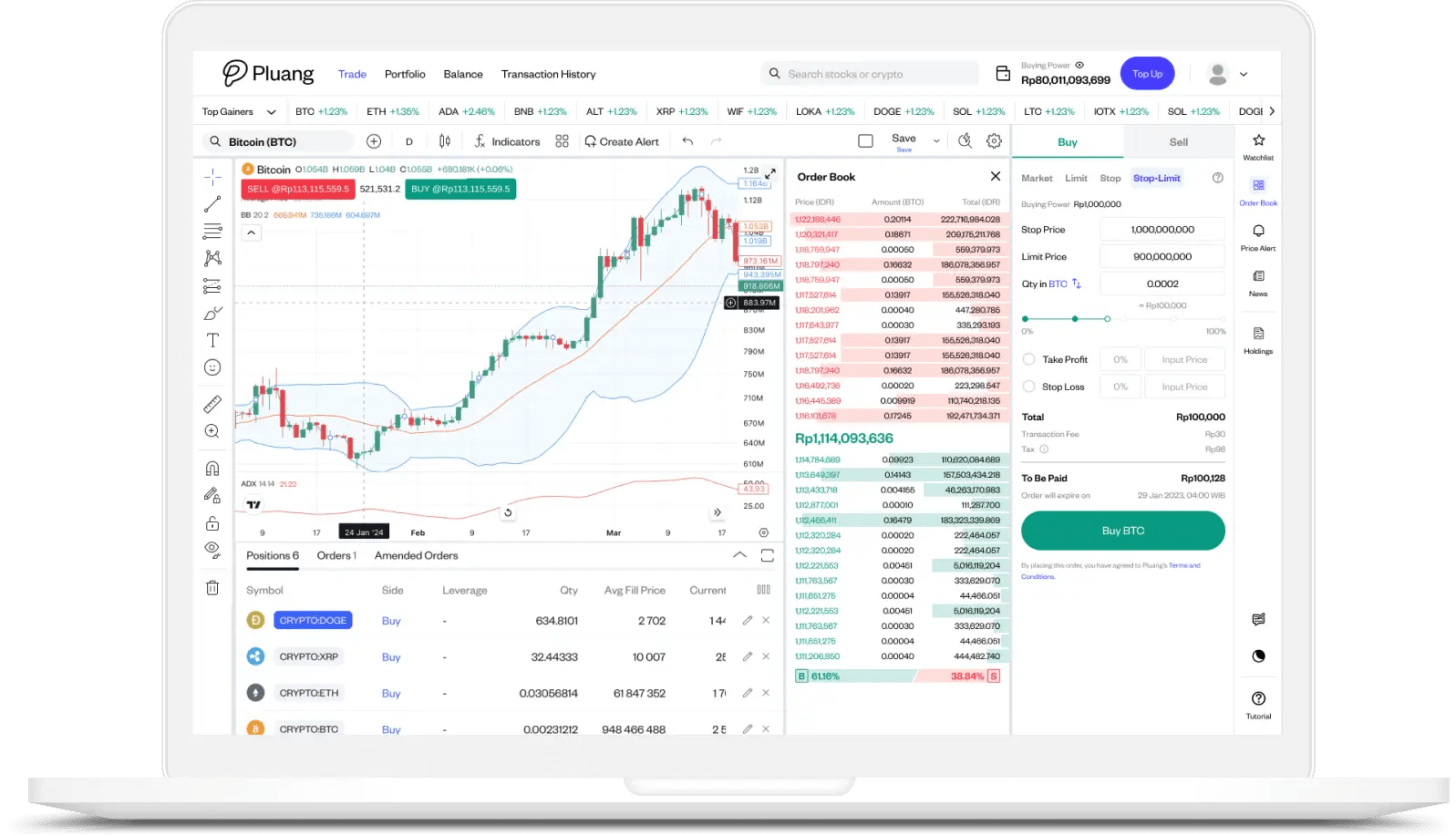
Investment platform Pluang secured a US$10 million Series C round led by MUFG Innovation Partners, with continued participation from Accel and Square Peg. The company revealed it had already achieved profitability prior to the funding, reflecting a broader shift among Southeast Asian startups toward sustainable growth models. Pluang has now reportedly raised around US$123 million in total funding while continuing to expand its retail investment offerings and regional ambitions. The momentum highlights how Indonesia’s wealth-tech sector is evolving from early adoption into a more mature and monetizable ecosystem supported by rising retail investor participation.
Eddy Chan’s Transition Marks a New VC Era
The decision by Intudo Ventures co-founder Eddy Chan to step back from an active role marks an important transition moment for Indonesia’s venture capital ecosystem. Since launching in 2017, Intudo has positioned itself as one of the few “Indonesia-only” VC firms, managing more than US$230 million in committed capital while backing startups such as Xendit, Pintu, Halodoc, and Populix. The leadership transition comes as Southeast Asia’s startup ecosystem increasingly shifts from founder-led experimentation toward stronger institutional continuity and succession planning. It also reflects how Indonesia’s VC landscape is entering a more mature phase, where long-term governance, portfolio durability, and ecosystem specialization are becoming equally important as growth.
Sayurbox and HappyFresh Explore Strategic Synergies
Potential merger talks between Sayurbox and HappyFresh signal how Indonesia’s online grocery market is entering a more disciplined growth cycle. Sayurbox itself previously raised more than US$120 million in Series C funding backed by Northstar, Alpha JWC, and IFC, highlighting the significant investor capital that has flowed into the sector over recent years. As competition tightens and operational efficiency becomes more critical, strategic consolidation could help strengthen logistics, supply chain resilience, and customer retention. The development reflects a broader ecosystem trend where sustainability and profitability are becoming just as important as rapid expansion.
Golden Lamian and Sour Sally Reflect Indonesia’s Consumer Confidence
The continued expansion of brands like Golden Lamian and Sour Sally reinforces how Indonesia remains one of Southeast Asia’s most attractive consumer markets. Rising middle-class spending power, urbanization, and stronger lifestyle consumption trends continue driving momentum across the F&B sector. Consumers today are increasingly experience-driven, pushing brands to compete not only on pricing but also on identity and customer engagement. The trend signals continued optimism around Indonesia’s long-term consumer economy story.
Oki Ramadhana Takes the Helm at INA
The appointment of Oki Ramadhana as CEO of Indonesia Investment Authority (INA) highlights the country’s continued effort to strengthen institutional investment leadership. Coming from Mandiri Sekuritas, Oki brings extensive experience across capital markets and strategic financing at a time when Indonesia is actively attracting global long-term investment flows. INA itself has become increasingly central in funding infrastructure, downstream industries, and strategic national projects. The leadership transition reinforces confidence in Indonesia’s ability to position sovereign investment vehicles as globally competitive institutions.
Danantara and Hisense Open New Industrial Opportunities
The partnership between Danantara and Hisense Group signals growing momentum around technology and industrial collaboration in Indonesia. Strategic partnerships with global electronics and manufacturing players can accelerate local capability building, supply chain integration, and innovation transfer. As Indonesia continues pushing industrial downstreaming and digital economy ambitions, collaborations like this become increasingly important in strengthening domestic production ecosystems. The country is no longer viewed solely as a consumption market, but also as a strategic regional manufacturing base.
VinFast Pushes Battery-Swapping Into Indonesia’s Massive EV Market
Vietnamese EV player VinFast officially launched battery-swapping electric motorcycles in Indonesia, targeting one of the world’s largest two-wheeler markets with over 120 million motorcycles nationwide. The battery-swapping model aims to solve one of the biggest EV adoption barriers: charging convenience and battery affordability. Indonesia’s dense urban mobility patterns make fast and scalable charging alternatives particularly relevant for mass adoption. The arrival of more regional EV challengers also accelerates innovation, infrastructure competition, and consumer awareness across Southeast Asia’s clean mobility ecosystem.
Southeast Asia’s quick commerce market closed 2025 at a $7.3 billion GMV, equivalent to 4.6% of the region’s total e-commerce market, and the momentum is only building. What’s remarkable is how this market is growing. Unlike China, where quick commerce replaced physical store trips, or India, where dark stores leapfrogged a thin retail network, SEA’s quick commerce is doing something smarter: layering on top of already-dense offline retail and food delivery infrastructure. Platforms like Grab, ShopeeFood, and Foodpanda entered this race with the riders, the merchant relationships, and hundreds of millions of MAUs already in place, giving them a structural head start that standalone players simply can’t replicate overnight.
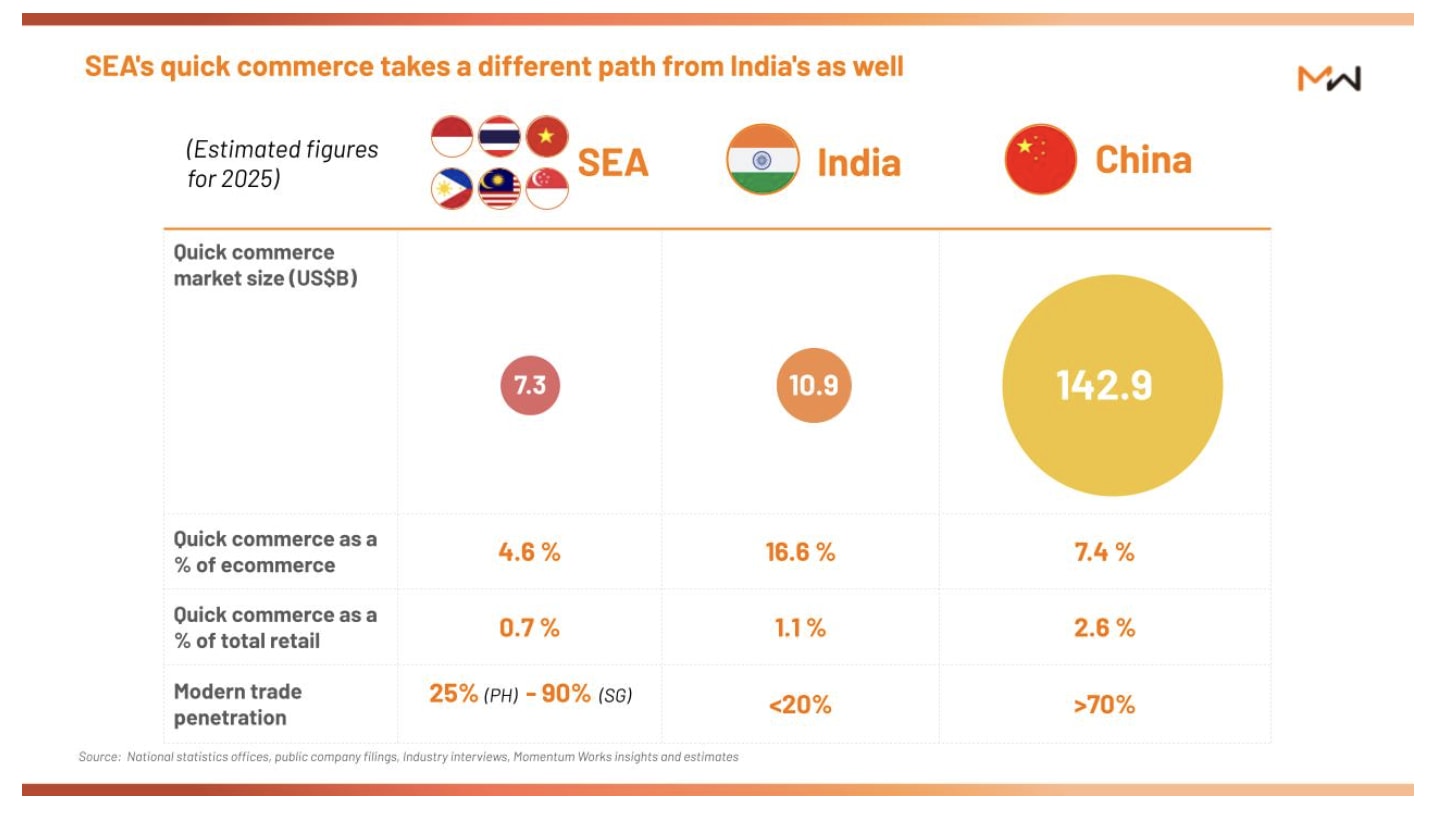
The supply side of quick commerce in SEA is essentially solved. The real challenge and the real opportunity is on the demand side. Consumers across the region haven’t yet built the habit of reaching for an app instead of walking to the minimart downstairs. In a price-sensitive region where offline retail is genuinely cheap and close, speed alone isn’t enough to shift behavior at scale. The report makes a counterintuitive but important point: it’s savings, not speed, that will ultimately unlock mass-market adoption. As long as on-demand delivery carries a price premium over offline, the category remains a luxury for the affluent and the time-pressed, not the everyday consumer.
For Indonesia, this story is especially relevant. With online grocery penetration sitting at just 2.8%, the lowest in the region, the headroom for growth is enormous. Momentum Works notes that Indonesia’s quick commerce expansion will be driven more by e-commerce platforms like Tokopedia, Shopee, and TikTok Shop than by minimarket chains, given the limited incentives for players like Indomaret and Alfamart to aggressively push into on-demand fulfilment. Indonesia’s combination of a massive mobile user base, dense offline retail fabric, and platform-driven commerce makes it one of the most distinctive and promising markets to watch as the region’s demand gap closes.