
ByClive Lindsay
BBC Sport Scotland
 Image source, SNS
It is that time of the year again when the Scottish Premiership splits into two sections of six teams and the arguments begin immediately about which team the final five rounds of fixtures favour.
It is not a random decision made by a computer. It is the governing body, the SPFL who make the final call, in consultation with rights holders who want the best games on live TV and the police.
The "who plays who" is obviously pre-determined, but the where and when is the result of many variables that have to be carefully considered and can leave the SPFL open to accusations of bias, favouritism, even conspiracy.
Reacting to Tuesday's post-split fixture reveal, Hearts head coach Derek McInnes acknowledged some fans will be disappointed that the tendency to give the league leaders going into the split a home game on the final day had not been adhered to.
However, he also accepted that the SPFL faces an impossible task to please all 12 clubs and their fans. But how is it all decided?
Why is there a split and what is it?
In its previous guise as the Scottish Premier League, the top flight had 10 clubs. That made a 36-game season with teams meeting four times. Ideal.
Then the division expanded to 12 for season 2000-01. And a 44-game campaign was deemed too long.
So an innovative split was introduced after the teams had met on three occasions. After that, the top six would play five more games among themselves and the bottom six would do the same.
It meant the top six were left playing for the title and European qualification places, while the bottom six were trying to avoid the one automatic relegation spot and the relegation/promotion play-off against a Championship side.
Upon their release of the fixtures, the SPFL pointed out that the split usually provides additional excitement, with clubs battling for a top-six place up until the 33rd fixture. Albeit Falkirk secured the final place with a game to spare this time.
However, cleaving the division in two after 33 matches can also produce some anomalies...
Do all clubs play an equal number home and away?
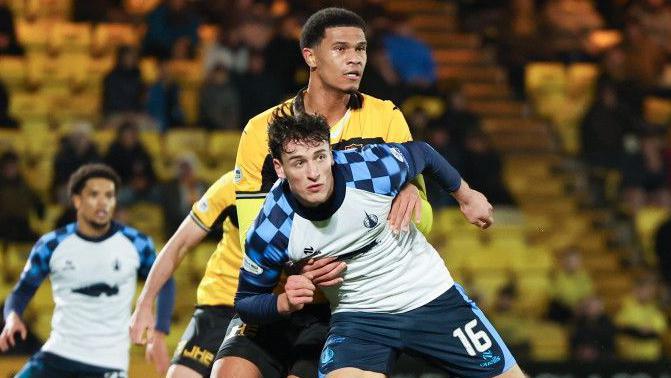 Image source, SNS
Livingston and Falkirk will have an imbalance of home and away games
Clubs play 16 or 17 home games in the 33 before the split - with a minimum of two, and a maximum of three, home fixtures after it.
Ideally, they should play 19 of each by the season's end, but that is not always possible - and this is the second season in a row that there has been an imbalance.
In compiling its initial fixtures, the SPFL tries to predict which clubs will end up in the top six and bottom six to best avoid such a scenario, but this season promoted Falkirk have overperformed and sit in sixth spot.
As a consequence, they will play 20 home games and Livingston will have 18.
Not ideal, but the SPFL explained that they have opted for that to mitigate the impact spreading too widely.
With Falkirk five points adrift of Hibernian, an extra home game is the least likely scenario to affect European qualification. And Livingston having one fewer home game means little given they are all but relegated already.
The Scottish top flight has had such a 20/18 scenario in nearly half of its seasons.
Does that cause any other imbalances?
It also means some sides play certain opponents three times at home and once away - or vice versa. Cue howls of complaint.
Such fixture reversals have been required in every season since the split was introduced in 2000-01 and this time there are four reversals in the top six.
Falkirk will host Rangers and Hibernian for a third time, and travel to Celtic Park and Tynecastle for a third time.
There are also three reversals in the bottom-six - Livingston will travel to Dundee and Dundee United for a third time and Kilmarnock will host Dundee a third time.
In coming up with those, the SPFL tries to avoid reversing fixtures that have a key impact on the battles for the title, European places and relegation.
It also tries to avoid reversing the big city derbies and may also take into account how clubs have been impacted by the post-split fixtures in previous years.
What impact does TV have?
'We'll play top six fixtures in a car park' - McInnes
Live television coverage is also taken into consideration and McInnes is unhappy Hearts will not have a single traditional Saturday 15:00 kick-off after the split.
Premier Sports have announced three live post-split broadcasts, while Sky Sports has confirmed six, with further selections for the final two rounds of games to come.
With Celtic v Falkirk selected for live broadcast on Saturday, 25 April, it also means the Rangers v Motherwell match has been switched to the Sunday.
That is because Police Scotland will not permit both Old Firm clubs being at home on the same day.
But who will be at home on the final day?
McInnes said he is just happy for his surprise long-time leaders to be involved in a three-way title race, with Rangers one point behind and Celtic two further back.
However, he recognised that some Hearts fans are unhappy that they have to travel to Celtic Park on the final day, when they are likely to only be allowed 600 visiting fans against the reigning champions.
The SPFL says Celtic have been given a home match on the final day partly because they have three home matches post-split and Hearts and Rangers only have two - but also cite "competing constraints and the most exciting title race in years making each fixture round very unpredictable".
So what are these constraints it has to balance?
The need for all clubs to finish home/away or away/home
The number of home matches each club has already had before the split
The need to avoid the two Dundee clubs, two Glasgow clubs and two Edinburgh clubs playing at home on the same day. This season's decision to have the second last fixtures on Wednesday, 13 May kick off at the same to allow equal recovery time also ruled out that date for such fixtures
City derbies are ruled out on the final day for public safety reasons
"We have a fantastic final day to look forward to with Celtic and Hearts facing off at Celtic Park, Rangers travelling to a Falkirk side that have been one of the success stories of the season and a potential battle for European spots at Easter Road," the SPFL added in a statement explaining the decisions.
This article is the latest from BBC Sport's Ask Me Anything team.